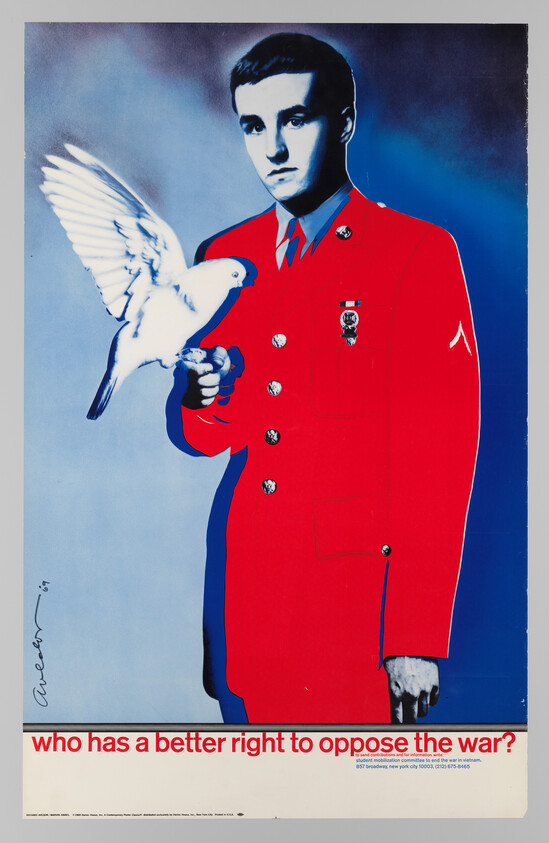
Here’s the story of how I came to pose for this poster by the great photographer Richard Avedon. (Yes, that’s a real dove.)
I served in the U.S. Army during Vietnam, an experience that made me realize the folly and horror of war. Uncle Sam turned me into a peace activist.
It was the summer of 1968, an unfortunate time to be a young man in the United States. Military draft calls were at their peak, with more than half a million U.S. troops on the ground in Vietnam. Most of my friends and my brother were already in the army. Within days of graduating from Notre Dame (goodbye student deferment!) a notice from the Selective Service arrived, ordering me to report for the draft. Soon I was in the army, my head reeling.
To avoid being sent into the infantry I signed up for the army band. Yes, I defended my country by playing a baritone horn and trumpet.
Before I entered the army I had not really thought about war. As I went through basic training, however, questions began to rise. The explanations our commanders gave for why we were in Vietnam did not ring true. The returning war veterans told harrowing tales of what they had experienced. ‘Wait’l you git there, sucka,’ an embittered vet shouted at me one day in the coffee shop.
Doubts began to swirl, and I started to read about Vietnam. Halfway through the first book (a history by Bernard Fall), I realized that almost everything our leaders were saying about the war was wrong. This was not ‘communist aggression from the North’ but a struggle by the Vietnamese to overthrow foreign domination and unite their country. The U.S. had supported French colonialism, violated the 1954 Geneva accords, turned the ‘temporary demarcation’ line dividing the two regions into a de facto border, created and funded a separate state in the south, and then sent an American army to prop it up. U.S. bombers were raining death and destruction across Vietnam, Cambodia and Laos. Questions turned to shock and outrage as I realized the war was unjust and immoral.
What to do?
I desperately wanted to escape, but it was too late. I was stuck in the army, a small part of the green machine, forced to participate in a cause I could not accept. I thought about deserting, or filing as a conscientious objector, but the former would have separated me permanently from family and friends, while the latter was not available to Catholics like me. I was angry and increasingly depressed. I had to do something.
One day I saw a magazine story about soldiers at Ft. Sill, Oklahoma, speaking out against the war and forming a servicemen’s union. That was it! I could oppose the war even as an active duty soldier. Perhaps if enough of us spoke out, political leaders might pay attention. I realized that speaking out would be risky, that I would likely face some kind of punishment or harassment as a result. But I didn’t care. I couldn’t continue with business as usual. I had to speak out against the madness and would face whatever consequences might come.
The rest, as they say, is history. I became part of the GI antiwar resistance, a story recounted in my book, Soldiers in Revolt. As active duty soldiers, we marched and spoke at antiwar demonstrations. We signed petitions of active duty soldiers against the war, the most famous of which appeared as a full-page ad in the New York Times the Sunday before the historic Moratorium rally in Washington in November 1969. When our commanders cracked down against us with harassment and punitive reassignments, we filed a lawsuit against the army.
One day in 1969, while I was stationed at Ft. Hamilton in New York, a representative of the Student Mobilization Committee asked if I would pose for an antiwar poster. Sure, I said, and a few days later I put on my uniform and arrived at the photography studio of one Richard Avedon. Yes, the Richard Avedon. At the time I had no idea who he was, so I didn’t know enough to be nervous. The resulting poster (yes, that’s a real dove) was widely used in the antiwar movement. It was not intended to be a portrait of me personally, but an image of the antiwar G.I. as archetype — the thinking soldier who asserts the right and duty to speak out against illegal and unjust war.
That was how I gained political consciousness and started on the path of working for justice and peace. I have not strayed from that path in all the years since. I guess I should be grateful to the army. It taught me about war, and convinced me of the need to study, teach and work for peace.
Originally published August 13, 2010
 David Cortright
You must be logged in to post a comment.